Best Facial for Melasma and Hyperpigmentation in Chicago: What to Look For Before You Book
If you are searching for the best facial for melasma or hyperpigmentation in Chicago, there is a good chance you have already tried more than one thing at home.
Maybe you bought a brightening serum.
Maybe you started using vitamin C.
Maybe you tried an exfoliating acid that someone on TikTok swore would fade dark spots.
Maybe your skin looked a little brighter for a while, but the brown patches across your cheeks, forehead or upper lip never really went away.
Or maybe your pigmentation actually became darker after you started trying to treat it.
This is where choosing the right facial matters.
At Lulu Beauty Spa in Chicago, we work with clients concerned about melasma, hyperpigmentation, uneven skin tone and stubborn dark spots. And one of the first things we explain is that there is not one facial that is automatically the best choice for every person with pigmentation.
The right treatment depends on your skin.
That may sound less exciting than promising one miracle facial that erases every spot, but pigmentation is one area where thoughtful treatment usually matters more than aggressive treatment.
If you are considering booking a melasma facial in Chicago, here is what you should look for before trusting someone with your skin.
First, What Is the Difference Between Melasma and Hyperpigmentation?
These words are sometimes used interchangeably, but they do not mean exactly the same thing.
Hyperpigmentation is a broad term for areas of skin that appear darker than the surrounding skin.
There are many possible causes.
You might develop post inflammatory hyperpigmentation after acne, picking at your skin, waxing, irritation or another type of inflammation.
You can also develop sun spots after years of ultraviolet exposure.
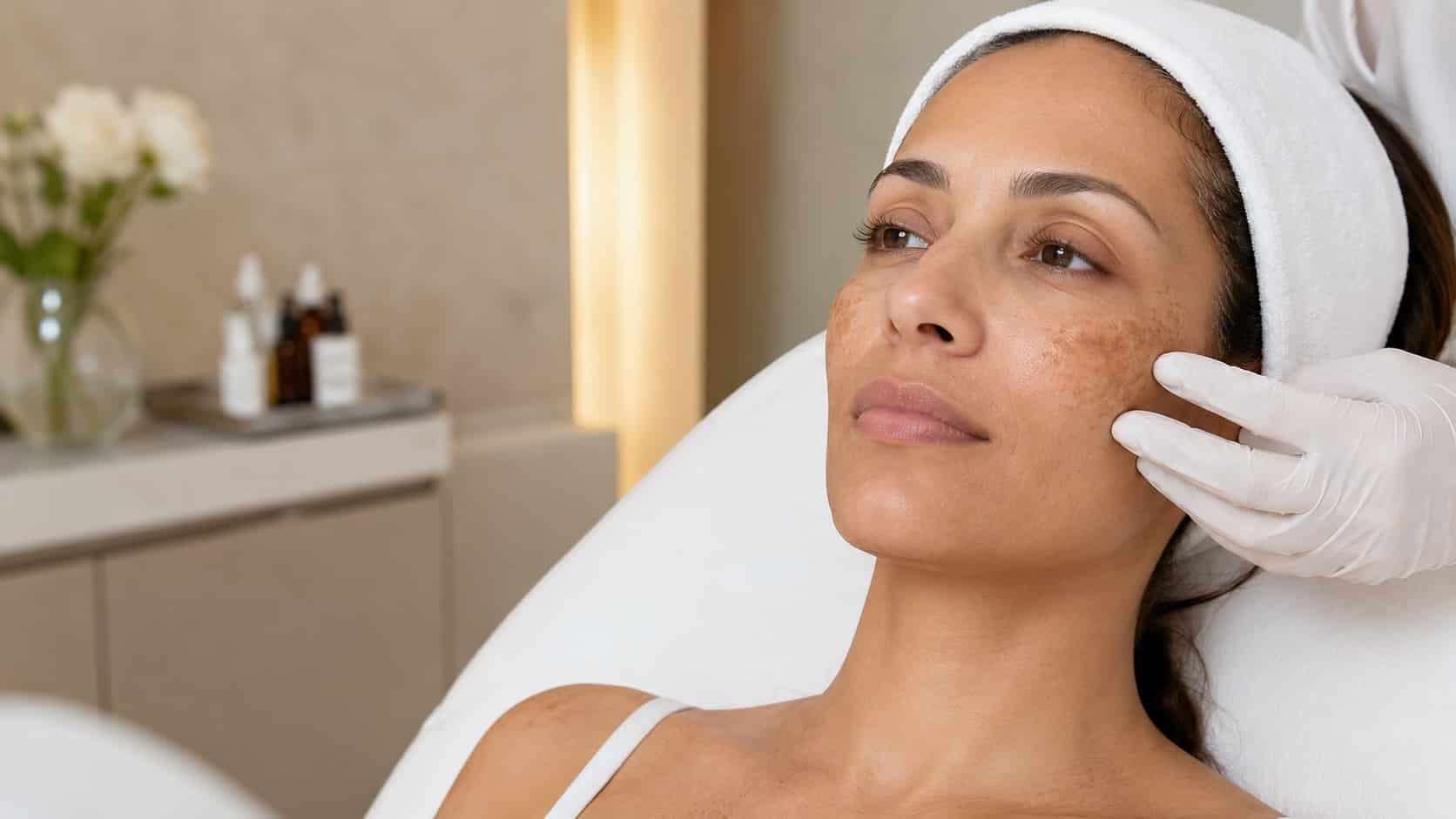
Melasma is a specific type of pigmentation that often appears as larger patches, commonly across the cheeks, forehead, nose, upper lip and chin.
Sun exposure is a major trigger, and hormones can also play a role.
This distinction matters because not every brown spot should be treated exactly the same way.
It is also important to remember that an esthetician can evaluate pigmentation from a cosmetic skincare perspective, but cannot medically diagnose melasma.
If something about your pigmentation looks unusual, changes rapidly or requires medical diagnosis, a dermatologist is the appropriate professional to evaluate it.
At Lulu Beauty Spa, knowing when not to treat something is just as important to us as knowing when we can help.
So What Is the Best Facial for Melasma?

There is no single facial that deserves that title for every person.
That is actually one of the biggest red flags to look for when choosing a facial for melasma.
If someone tells every pigmentation client that they need exactly the same treatment, regardless of their skin tone, sensitivity, current products, history or type of pigmentation, that should make you pause.
Melasma can be stubborn and easily aggravated.
The American Academy of Dermatology notes that there is no single best melasma treatment for everyone. Treatment is usually individualized according to factors such as skin tone, triggers and the depth of pigmentation.
The same logic should apply when choosing cosmetic skincare.
A good pigmentation facial should begin with your skin, not with a predetermined protocol.
For one person, carefully controlled exfoliation may make sense.
For another, calming inflammation and rebuilding the skin barrier may need to happen first.
Someone else may need to be referred to a dermatologist before beginning a facial treatment plan.
The best treatment is the one that makes sense for the skin sitting in front of us.
Look for Someone Who Actually Understands Pigmentation
Pigmentation should not simply be treated as another add on to a regular facial.
If dark spots or melasma are your main concern, you want someone who pays attention to how pigment behaves.
That includes understanding that irritation can make discoloration worse.
If you already know that pimples leave dark marks on your skin for months, that is useful information.
If waxing leaves pigmentation behind, that matters.
If your skin becomes dark anywhere it has been irritated, we want to know that too.
These clues tell us something important about how your skin responds to inflammation.
The American Academy of Dermatology specifically recommends gentle skincare for people dealing with melasma because products that sting or irritate the skin can cause dark spots to become darker.
That is why a pigmentation focused facial should never simply be about using the strongest products available.
Sometimes restraint is part of good skincare.
Your Consultation Should Matter as Much as the Facial
If you walk into an appointment for melasma or hyperpigmentation and nobody asks you questions before beginning treatment, that is a problem.
We want to know what you are using at home.
Do you use retinol?
Prescription tretinoin?
Exfoliating acids?
Hydroquinone prescribed by a dermatologist?
Vitamin C?
Brightening serums?
Scrubs?
Have you had a chemical peel recently?
Have you received laser treatments?
Does your pigmentation become noticeably darker during the summer?
Did it begin during pregnancy?
Did it appear after another hormonal change?
Do you have sensitive skin?
Have previous treatments irritated you?
All of those details can influence what makes sense for your skin.
At Lulu Beauty Spa, we do not want to simply look at your face for thirty seconds and decide which facial you need.
We want to understand what your skin has already been through.
Be Careful With Anyone Promising to Permanently Remove Melasma
Melasma can improve.
Sometimes it can improve significantly.
But it is also known for recurring.
That means you should be skeptical of anyone who promises to permanently erase melasma with one facial, one peel or one miracle product.
Dermatologists describe melasma as a condition that can remain for years, and even when treatment improves it, triggers such as sunlight can cause pigmentation to return.
At Lulu Beauty Spa, we would rather set realistic expectations from the beginning.
Our goal is to improve the appearance of your pigmentation when appropriate, support healthier looking skin and help you build habits that make maintaining your results easier.
We are not going to promise something that skin biology cannot guarantee.
Should a Melasma Facial Include Exfoliation?
It can.
But this is where the details matter.
Exfoliation can help remove accumulated surface cells and may improve the appearance of uneven skin tone.
That does not mean more exfoliation automatically gives you better results.
If your skin is already irritated because you are using several active ingredients at home, adding aggressive exfoliation may not be the best first step.
A good pigmentation treatment should consider what your skin can tolerate.
Think of it this way.
The goal is not to peel as much skin off as possible.
The goal is to create improvement without causing unnecessary inflammation.
Those are two very different approaches.
What About Chemical Peels for Hyperpigmentation?
Chemical peels can be useful for certain pigmentation concerns when appropriately selected.
But again, not every peel is appropriate for every person.
This becomes especially important with medium, olive and deeper skin tones because inflammation itself can lead to additional pigmentation.
A stronger peel is not automatically a better peel.
At Lulu Beauty Spa, we believe the question should be:
What does this particular skin need?
Not:
What is the strongest thing we can put on it?
If you are considering a chemical peel for melasma or hyperpigmentation, your provider should ask about your skin history, sensitivity, home products and previous treatments first.
What Should Someone With Latina or Melanin Rich Skin Look For?
This deserves its own section because Chicago has such a diverse population.
Many of our clients have Latina, olive, medium or deeper skin tones.
Pigmentation can behave differently in skin that produces melanin easily.
Dark spots after acne may last longer.
Inflammation can leave visible discoloration.
Aggressive treatments can sometimes create the exact problem you were trying to correct.
This does not mean deeper skin tones cannot receive professional exfoliation or pigmentation treatments.
It means those treatments should be selected thoughtfully.
If your provider does not ask how your skin reacts to irritation, that is something worth paying attention to.
At Lulu Beauty Spa, we want to know how your skin behaves before deciding how to treat it.
Is a Brightening Facial the Same as a Melasma Facial?
Not necessarily.
The word brightening gets used for almost everything in skincare.
A brightening facial might be designed to make dull skin look more radiant.
That is not automatically the same thing as developing a treatment plan for someone with persistent facial pigmentation.
If melasma or dark spots are your primary concern, tell your esthetician.
Do not simply book whatever facial has the word glow in its name and assume it is designed for pigmentation.
Your provider should understand what your actual goal is.
Sunscreen Is Part of Your Melasma Treatment Whether You Like It or Not
This may not be the glamorous part of a facial, but it is one of the most important conversations we can have with a pigmentation client.
If you are investing money into facials but repeatedly exposing your skin to the sun without adequate protection, it becomes much harder to control pigmentation.
And Chicago weather does not make us exempt.
Clouds do not mean ultraviolet exposure disappears.
Winter does not mean sunscreen suddenly becomes irrelevant.
For melasma, visible light matters too.
Dermatologists often recommend tinted sunscreen containing iron oxides because visible light can contribute to melasma, particularly in people with darker skin tones.
If nobody has ever talked to you about the sunscreen you are using while you are spending money trying to improve pigmentation, that conversation is overdue.
How Often Should You Get a Facial for Hyperpigmentation?
There is no universal schedule.
This depends on the treatment, your skin, your goals and what you are doing at home.
More appointments do not automatically mean faster improvement.
Sometimes your skin needs time between treatments.
A good treatment plan should be based on how your skin responds rather than simply putting you on the most frequent schedule possible.
At Lulu Beauty Spa, we want your appointments to have a purpose.
If your skin needs time before another active treatment, we will tell you.
How Long Does Hyperpigmentation Take to Fade?
This depends heavily on what caused it and how deep the pigment is.
Some superficial pigmentation can gradually fade over several months once the trigger is controlled.
Deeper pigment can take considerably longer.
The American Academy of Dermatology notes that some dark spots may take six to twelve months to fade, while deeper discoloration can take years.
That does not mean professional treatment cannot help.
It means realistic expectations matter.
Pigmentation is usually a long game.
If you are expecting every spot to disappear immediately after one appointment, you are likely to become frustrated.
We would much rather show you gradual, sustainable progress than promise an overnight transformation.
How Do You Know If Your Facial Is Working?
Do not judge your progress only by how your skin looks the morning after an appointment.
Hydrated skin often looks brighter temporarily.
That is nice, but pigmentation improvement should be evaluated over a longer period.
Progress photos can be extremely useful.
Try to take them in similar lighting.
Look at the size of the pigmented areas.
Look at whether the borders appear softer.
Look at whether your overall skin tone appears more even.
Also pay attention to whether new pigmentation is continuing to develop.
Sometimes preventing the problem from constantly becoming worse is an important part of progress.
When Should You See a Dermatologist Instead?
There are situations where a dermatologist should be part of your plan.
If you do not know whether your pigmentation is actually melasma, a dermatologist can diagnose it.
If your pigmentation is new or unusual, get it evaluated.
If a spot changes shape, color or texture, do not assume it is simply hyperpigmentation.
If you have persistent melasma that is not responding to cosmetic skincare, a dermatologist may also discuss prescription treatment options.
Medical and esthetic care do not need to compete with each other.
Sometimes they complement each other.
At Lulu Beauty Spa, if something is outside our scope, we would rather tell you than pretend otherwise.
Questions to Ask Before Booking a Melasma Facial in Chicago
Before trusting someone with your pigmentation, ask questions.
Ask whether they regularly work with hyperpigmentation.
Ask how they approach melasma prone skin.
Ask whether every pigmentation client receives the same treatment.
Ask what happens if your skin is too irritated for an active facial.
Ask whether they have experience working with your skin tone.
Ask what you should use at home.
Ask what products you should stop before treatment.
Ask what realistic results look like.
Ask what happens if your pigmentation does not respond.
And pay attention to how those questions are answered.
A good skincare professional should be willing to explain the reasoning behind the treatment instead of making you feel like you are asking too much.
What Makes Lulu Beauty Spa Different for Pigmentation Facials in Chicago?
We are intentionally putting more focus on melasma, hyperpigmentation and stubborn dark spots because we see how frustrating these concerns can be.
Pigmentation clients often come in after spending a lot of money already.
They have drawers full of products.
They have tried viral routines.
They have been told to exfoliate more.
They have been told to use stronger products.
And sometimes nobody has stopped long enough to ask how their particular skin actually reacts.
That is where we want to be different.
At Lulu Beauty Spa, we believe pigmentation needs a plan.
We look at your skin tone.
Your sensitivity.
Your current routine.
Your history.
Your triggers.
Your previous treatments.
Your expectations.
And then we decide what makes sense.
Sometimes that means starting gently.
Sometimes it means addressing the skin barrier before focusing aggressively on pigmentation.
Sometimes it means professional exfoliation.
And sometimes it means telling you that we think you should speak with a dermatologist.
We are interested in the long term health and appearance of your skin, not simply selling you the strongest facial on the menu.
Looking for a Melasma or Hyperpigmentation Facial in Chicago?
If dark patches, uneven skin tone or stubborn pigmentation have been bothering you, you do not have to keep guessing at home.
You also do not need another random facial chosen because the description sounded good online.
Come in and let us actually look at your skin.
At Lulu Beauty Spa in Chicago, we are focused on helping clients with melasma prone skin, hyperpigmentation and dark spots take a more thoughtful approach to professional skincare.
We will talk about what you have tried.
We will talk about what may be triggering the pigmentation.
We will look at what your skin can realistically tolerate.
And we will help you determine what makes sense as your next step.
If you are unsure which facial to book, call or text us at 773 870 2816.
You can tell us what you are seeing on your skin, what you have already tried and what you are hoping to improve.
We would rather help you choose the right appointment than have you book something your skin does not need.
If you have been searching for the best facial for melasma and hyperpigmentation in Chicago, remember this:
The best facial is not necessarily the strongest facial.
It is not necessarily the most expensive facial.
And it is definitely not the facial making the biggest promises.
It is the treatment chosen by someone who understands pigmentation, respects your skin and knows that improving dark spots requires more than attacking them.
Ready to stop guessing? Book your pigmentation focused facial with Lulu Beauty Spa in Chicago today or call or text 773 870 2816 with any questions before scheduling.